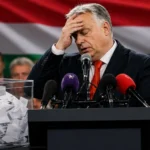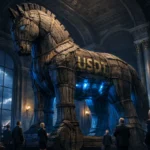

For 16 years, Viktor Orbán served as Vladimir Putin’s mouse — the Kremlin’s most valuable asset inside the European Union. The lion pulled the strings; the mouse blocked Ukraine aid, sabotaged EU sanctions, monopolised Hungarian media, and ran the country’s economy into the ground while getting personally rich in the process. On April 12, 2026, Hungarian voters finally called the pest control. Orbán’s Fidesz collapsed from 135 seats to just 52. Péter Magyar’s Tisza party won a historic supermajority of 141 seats. The mouse is done. What comes next for Hungary — and what does this regime change reveal about the price of 16 years of illiberal sovereignty?
KEY TAKEAWAYS
- Orbán functioned as Putin’s primary instrument inside the EU — blocking Ukraine aid, vetoing sanctions, and shielding Kremlin interests for 16 years at Hungary’s expense.
- Tisza won 141 of 199 parliamentary seats (53.6% of the vote) — the largest mandate any single party has ever received in a free Hungarian election.
- Hungary’s economic damage is severe: 57% cumulative inflation since 2020, 5.6% fiscal deficit, debt-to-GDP rising toward 75%, and the lowest individual consumption per capita in the EU.
- Magyar’s first priority is unlocking €17–18 billion in frozen EU funds — but the deadline is August 31, 2026, and 27 institutional milestones must be met first.
- Orbán remains in parliament with 52 seats as opposition leader — the mouse is cornered, not gone.
- Like Bulgaria’s Delyan Peevski, Orbán represents the media-oligarch model of political control: capture the press, control the narrative, maintain impunity.
- The Kremlin lost its most powerful EU insider. The geopolitical consequences — for Ukraine, for EU unity, for the frozen €90 billion loan — are immediate and significant.
1. The Lion and the Mouse: A 16-Year Political Fable
There is an old fable about a lion and a mouse. The lion is powerful, feared, and in control. The mouse survives by being useful to the lion — running errands, opening doors, keeping smaller predators at bay. The mouse does not act in its own interest. It acts in the lion’s interest, in exchange for protection.
For 16 years, Viktor Orbán was Vladimir Putin’s mouse inside the European Union.
This is not a metaphor conjured for rhetorical effect. It is a structural description of how Hungarian foreign policy functioned between 2010 and 2026. Orbán blocked EU sanctions on Russia when they required unanimity. He vetoed the €90 billion EU loan to Ukraine — holding the entire bloc hostage to Kremlin preferences. He cultivated a €10 billion Russian nuclear energy deal (Paks II) that made Hungary structurally dependent on Moscow’s goodwill. He maintained personal diplomatic channels with Putin even after Russia’s full-scale invasion of Ukraine in 2022, positioning himself as an unofficial Kremlin intermediary at a moment when Europe needed unity above all else.
The lion was always in control. The mouse was always serving.
On April 12, 2026, Hungarian voters called the pest control. The 16-year arrangement is over. And the consequences — for Hungary, for Europe, for Ukraine, and for Vladimir Putin — are profound.
2. The Night the Mouse Lost
Viktor Orbán had won four consecutive parliamentary supermajorities since 2010. He had survived Article 7 proceedings, EU fund freezes, coordinated opposition campaigns, mass protests, and the full weight of Brussels institutional pressure. He had rewritten Hungary’s constitution, packed the courts with loyalists, gerrymandered electoral districts, and built a media empire that ensured his message saturated every Hungarian living room. He was, by any measure, the most entrenched leader in the European Union.
And then Péter Magyar appeared.
Magyar — a 45-year-old former Fidesz insider, ex-husband of a former justice minister — turned against the system from within. He founded Tisza in March 2024. Within months it was polling ahead of Fidesz. By election night on April 12, 2026, the results were historic.
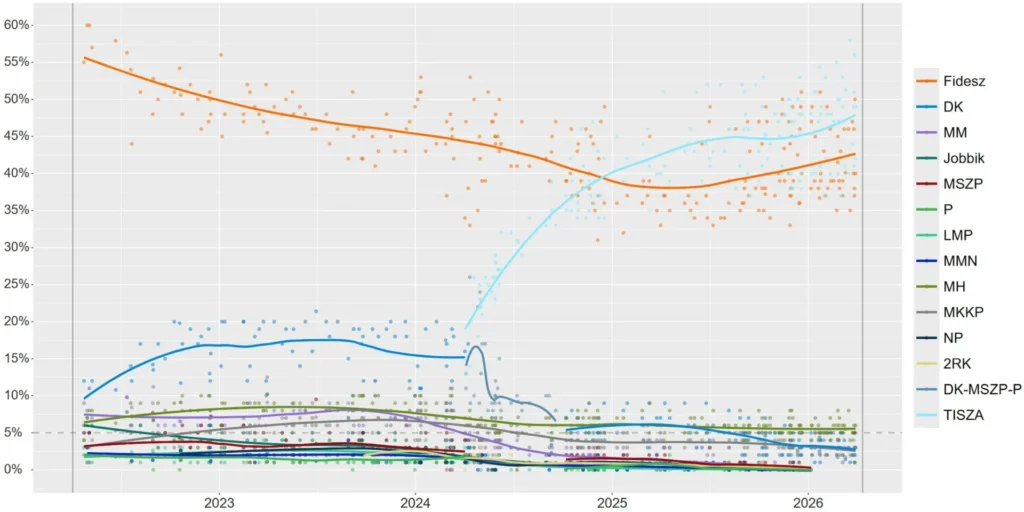
Hungary 2022–2026 Polling Trends: Tisza overtakes Fidesz | Source: Wikipedia / 2026 Hungarian Parliamentary Election
The polling chart tells the story of a political tectonic shift. Fidesz, which had commanded 50–60% support as recently as 2022, collapsed below 40% as Tisza surged past them in early 2025 and never looked back. The crossover point — the moment the mouse’s political protection ran out — is visible in the data.
Final results: Tisza won 53.18% of the party-list vote and 55.26% of constituency votes, translating into 141 of 199 parliamentary seats — a supermajority sufficient to amend Hungary’s constitution. Fidesz collapsed to 52 seats, down from 135. Mi Hazánk, the far-right splinter, took 6 seats.
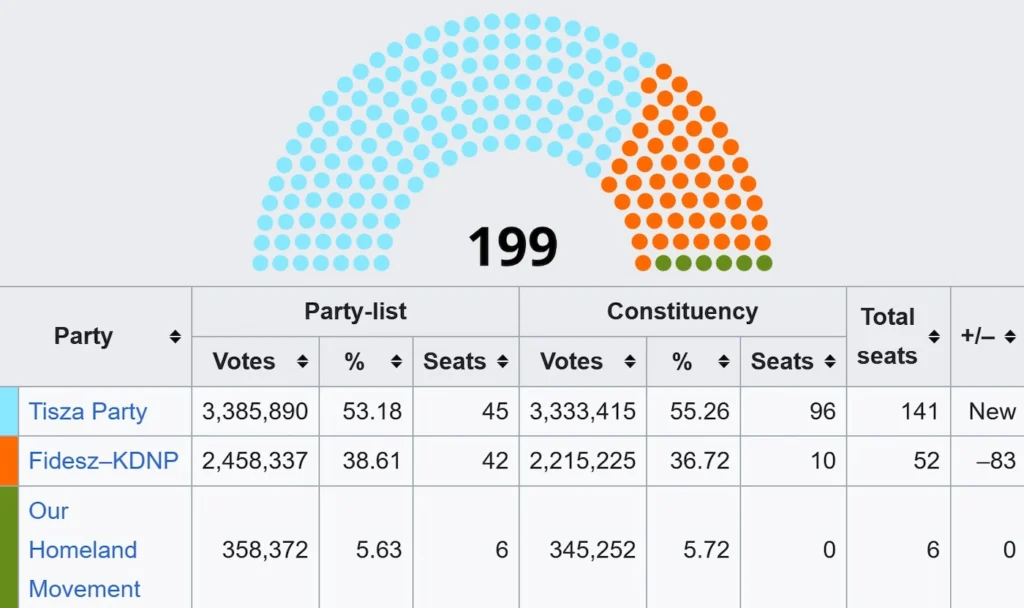
Hungary 2026 National Assembly — Seat Distribution (199 seats total) | Source: Wikipedia / 2026 Hungarian Parliamentary Election
The hemicycle is a visual verdict. The blue of Tisza dominates the chamber. The orange of Fidesz is reduced to a corner. For the first time since 2010, Hungary has a parliament that does not serve one man’s interests.
“Tonight, truth prevailed over lies. Today, we won because Hungarians didn’t ask what their homeland could do for them; they asked what they could do for their homeland.” — Péter Magyar, victory speech, April 12, 2026
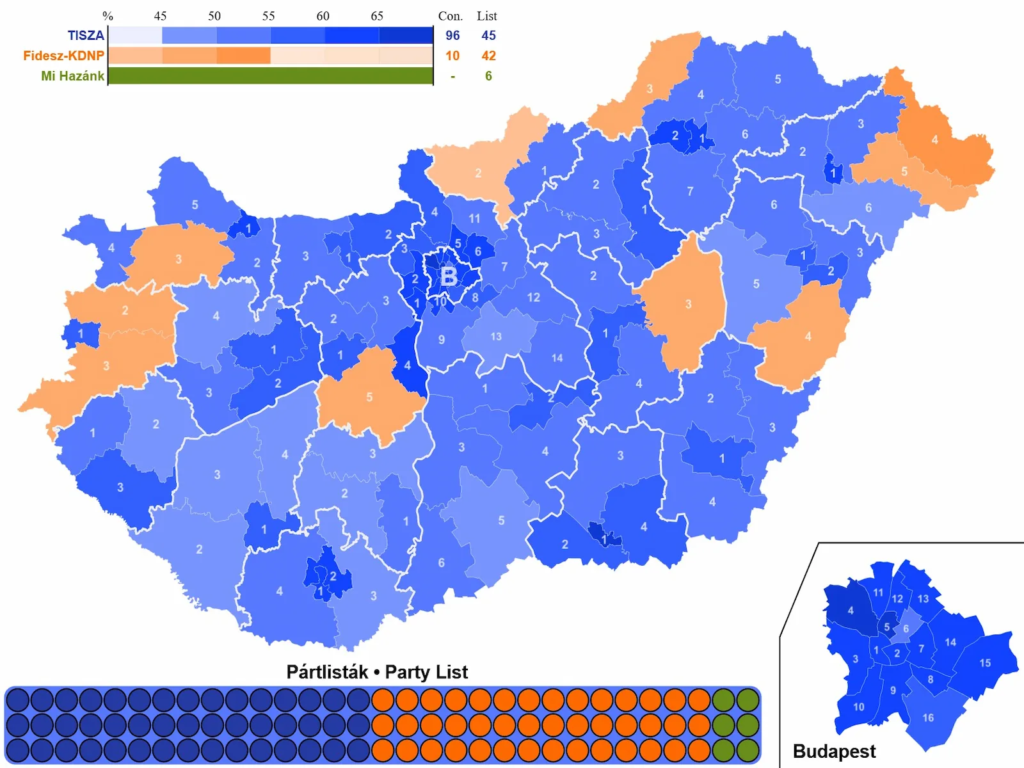
Hungary 2026 Parliamentary Election — Results by District | Source: Wikipedia / 2026 Hungarian Parliamentary Election
The geographic map completes the picture. Blue dominates across Hungary. Fidesz orange survives only in scattered rural strongholds in the east and northeast — the regions most dependent on state patronage, most saturated by pro-government media, and most isolated from urban economic realities. Even there, the margins are narrower than ever before.
3. What Orbánomics Actually Cost Hungary
To understand the scale of Magyar’s mandate, you need to understand what 16 years of Orbánomics actually produced — not the propaganda version, but the economic reality.
Hungary’s cumulative inflation since 2020 reached 57% — nearly double the EU average of 28%. In early 2023, monthly inflation peaked at 26%, the highest in the European Union. Wages rose, but prices rose faster. The forint depreciated significantly against the euro and dollar, making imports — including energy — dramatically more expensive. The pre-election fiscal giveaways of both 2022 and 2026 each cost over 2% of GDP and produced short-term relief while worsening long-term structural positions.
The fiscal numbers Magyar inherits are sobering. The deficit stands at approximately 5.6% of GDP in 2026, with Hungary under EU excessive deficit procedure. Debt-to-GDP is approaching 75% and rising. GDP growth was close to stagnation through 2024–2025. And Hungary recorded the lowest level of actual individual consumption per capita in the entire European Union — 72% of the EU average. After 16 years of “Hungary First,” Hungarians were consuming less in real terms than citizens of almost every other EU member state.
This is what sovereignty without accountability produces. Orbán had full control of monetary signalling, fiscal policy, and institutional architecture. He used it — selectively, strategically, and ultimately self-destructively — to maintain power rather than build prosperity.
“The election result is painful for us, but clear.” — Viktor Orbán, concession speech, April 12, 2026
4. The Media Empire: Controlling the Narrative
Orbán’s political survival was not built on economic performance alone. It was built on information control — the systematic capture of Hungary’s media landscape to ensure that the Kremlin’s mouse always looked, to Hungarian audiences, like a Hungarian lion.
By 2026, approximately 80% of Hungarian media was controlled by Fidesz-aligned oligarchs. Television, radio, newspapers, and online platforms had been consolidated into a unified pro-government narrative machine. Independent outlets faced advertising boycotts, regulatory harassment, and outright acquisition by politically connected buyers. The result was an information environment in which government failures were minimised, opposition figures were demonised, and Russia’s war in Ukraine was framed as NATO aggression rather than imperial invasion.
This media model did not originate in Hungary. It was exported — in blueprint form, in financing, and in political inspiration — across Central and Eastern Europe. Bulgaria felt its effects directly. Delyan Peevski, the Movement for Rights and Freedoms leader sanctioned under the US Magnitsky Act, built a media empire spanning dozens of Bulgarian publications that operated by the same principle: capture the press, control the narrative, maintain the network’s impunity.
Orbán and Peevski represent two versions of the same playbook — the media-oligarch model of democratic capture. The fourth pillar of power — the press — transformed from a check on power into an instrument of it. The difference in scale is significant: Orbán operated at the level of an EU member state government; Peevski operated at the level of a national party and business network. But the architecture is identical. This publication has examined Bulgaria’s own version of this phenomenon in depth.
The April 2026 Bulgarian elections — which delivered a historic 44.59% majority to Progressive Bulgaria’s Rumen Radev — represent the same democratic impulse that drove Magyar’s victory in Hungary: a popular rejection of a political-oligarchic network that captured institutions, controlled media, and maintained impunity at the expense of ordinary citizens. Read the full analysis: The Euro Is in Your Wallet. The Man Who Opposed It Now Runs Your Country.
5. Orbán and Peevski: Two Oligarchs, One Playbook
Place Viktor Orbán and Delyan Peevski side by side and the structural similarities are striking — and instructive.
Both built their power on the same three pillars: media ownership, judicial capture, and political impunity. Both used their respective positions to block investigations, redirect state resources to allied businesses, and systematically weaken the institutional checks that democratic systems depend on. Both cultivated relationships with Moscow that served the Kremlin’s interest in fragmenting European unity. And both became, in their respective contexts, the most publicly recognised faces of the corruption that their electorates eventually rose against.
Peevski’s Magnitsky Act designation by the US Treasury is the international legal record of what his network represented. Orbán’s 16-year relationship with Putin — the handshake visits to the Kremlin, the Paks II nuclear deal, the Ukraine veto — is the geopolitical record of what his represented. Neither operated in isolation. Both were nodes in a broader network of illiberal governance that stretched from Budapest to Sofia, from Warsaw to Belgrade, sustained by Kremlin financing, Kremlin media, and Kremlin strategic patience.
The difference today is one of trajectory. Peevski’s network in Bulgaria is under direct institutional threat from Radev’s new government. Orbán’s network in Hungary is under direct institutional threat from Magyar’s supermajority. Both mice, it appears, are being cornered simultaneously — and not by coincidence.
“This is not a change of government. It is the start of a change of regime.” — Dr. Stefano Bottoni, historian, on Magyar’s victory
6. Magyar’s Mission: Reform, EU Funds, and the August Deadline
Péter Magyar inherits a country in institutional and fiscal crisis. His first and most urgent task is also his most time-sensitive: unlocking the €17–18 billion in EU structural and cohesion funds frozen over Hungary’s rule-of-law violations since 2022.
The European Commission dispatched a high-level delegation to Budapest — led by Björn Seibert, chief of staff to Commission President Ursula von der Leyen — within days of Magyar’s victory. The message from Brussels was unambiguous: the institutional machinery is ready to open, but Hungary must demonstrate it has met 27 specific rule-of-law milestones. The hard deadline for submitting a formal payment request is August 31, 2026. It is, according to the Commission, immovable.
The good news: Magyar’s electoral programme goes beyond what Brussels has required. Tisza has committed to joining the European Public Prosecutor’s Office, restoring judicial independence, and overhauling the Recovery and Resilience Plan to focus on railway modernisation, electricity grid upgrades, and green transition. The EU’s milestones and Magyar’s domestic reform agenda are largely aligned.
The bad news: Orbán’s government, still in caretaker status until Magyar takes office in May, is reportedly destroying documents that could expose corruption. The institutional infrastructure of 16 years of captured governance — loyalists in courts, prosecutors, regulatory bodies, and state media — cannot be dismantled in weeks. Magyar has the constitutional tools; the question is whether the implementation capacity exists in a party that has never governed.
On monetary policy, Magyar has signalled intent to pursue eurozone membership, with a tentative 2030–2031 timeline. From Hungary’s current fiscal position — 5.6% deficit, 75% debt-to-GDP — this is an aspirational direction, not an imminent reality. But the direction matters. A credible eurozone candidacy would reduce Hungary’s risk premium, anchor inflation expectations, and provide the same disciplining framework that Bulgaria’s currency board provided from 1997: external rules that constrain domestic fiscal recklessness.
7. The Geopolitical Shockwave
Orbán’s defeat sent shockwaves far beyond Budapest. Within hours of the result, European capitals that had spent years managing Hungary’s obstruction began recalibrating.
The most immediate consequence is Ukraine. Orbán had personally blocked the EU’s €90 billion loan to war-battered Ukraine, exploiting the unanimity requirement in EU foreign policy to exercise a veto that served Moscow’s interest in exhausting Kyiv financially. Magyar has explicitly committed to removing that veto. The path to the €90 billion — frozen for over a year by a single pro-Kremlin government — has reopened.
The second consequence is EU institutional coherence. Hungary under Orbán had been the EU’s most reliable disruptor — blocking sanctions packages, delaying decisions, and forcing lowest-common-denominator compromises on issues ranging from migration to rule-of-law enforcement. A Hungary that genuinely reorients toward Brussels changes the political arithmetic of every qualified majority vote in the Council.
The third consequence is Putin himself. Orbán was not merely a convenient ally — he was a strategic asset whose value derived precisely from his position inside a democratic, rules-based institution. A Kremlin-aligned government with veto power inside the EU was worth more to Moscow than any number of friendly governments outside it. That asset is now gone. The mouse has been caught. And the lion, for once, is the one who lost something.
“Orbán’s defeat will deprive Russian President Vladimir Putin of his main ally in the EU and send shockwaves through Western right-wing circles.” — Al Jazeera, April 12, 2026
8. Conclusion: The Mouse Is Cornered, Not Gone
Viktor Orbán is not finished. He sits in parliament with 52 seats as opposition leader, commanding a loyal base of roughly 37% of Hungarian voters — people who genuinely benefited from his patronage network, who consumed only pro-government media for 16 years, and who experienced Magyar’s victory not as liberation but as loss. He will obstruct, litigate, and attempt to exhaust Magyar’s reform agenda through every institutional mechanism available to him. The mouse is cornered. It is not tame.
But the structural reality has changed irreversibly. Magyar’s supermajority can rewrite the constitution, replace loyalist judges, reform electoral law, and dismantle the media ownership structures that made Orbánomics politically sustainable. The tools exist. The mandate is historic. The question is whether the will — and the governing capacity — match the moment.
For the broader European picture, Hungary’s election sits alongside Bulgaria’s as evidence of a pattern: across the EU’s eastern periphery, the oligarchic-media model of democratic capture is facing its most serious electoral challenges in a generation. The same week that Magyar unseated Orbán in Budapest, Radev won a historic majority in Sofia on an anti-corruption mandate. The pest control, it seems, is working in multiple countries simultaneously.
What both victories share is this: they were not delivered by Brussels, by EU conditionality, or by institutional pressure. They were delivered by ordinary citizens who experienced, in their daily lives, the material cost of captured governance — in their inflation bills, their hospital waiting rooms, their emigrating children, their silenced journalists. Democratic accountability, when it finally arrives, tends to arrive not through institutions but through wallets and patience running out simultaneously.
The lion still sits in the Kremlin. But he has lost his mouse. And Europe, for the first time in 16 years, has one fewer open door into its institutions for Kremlin interests to walk through.
That is not nothing. In the current geopolitical moment, it may be everything.
References & Sources:
All sources used in this analysis are primary institutional publications, tier-1 financial media, or official electoral data.
1. Al Jazeera: “Peter Magyar wins Hungary election, unseating Viktor Orban after 16 years” — April 12, 2026 | aljazeera.com
2. CNN: “Hungary election 2026 results: Péter Magyar wins, Trump ally Viktor Orbán concedes landmark defeat” — April 12, 2026 | cnn.com
3. Euronews: “EU and Magyar agreed to work together for release of EU cash after weekend talks” — April 19, 2026 | euronews.com
4. Christian Science Monitor: “Péter Magyar’s goal now is to reform Orbán’s Hungary. EU funds are at stake.” — April 20, 2026 | csmonitor.com
5. EUNews.it: “Péter Magyar in talks with von der Leyen: ‘Unblocking EU funds for Hungary is a key priority” — April 14, 2026 | eunews.it
6. Wikipedia: “2026 Hungarian parliamentary election” (referenced April 23, 2026) | en.wikipedia.org
7. OMFIF: “Does the end of Orbánomics mean a fresh start for Hungary?” — April 2026 | omfif.org
8. Irish Times: “Orbanomics failure costs Hungary’s strongman his grip on power” — April 13, 2026 | irishtimes.com
9. OSW Centre for Eastern Studies: “Stable stagnation: Hungary’s economic standing after 16 years of Orbán’s rule” — March 2026 | osw.waw.pl
10. European Commission: “Economic Forecast for Hungary” — Autumn 2025 | economy-finance.ec.europa.eu
Disclamer: This article is published for informational and analytical purposes only. It does not constitute financial, legal, or investment advice. The views expressed are those of the author based on publicly available information. Readers should conduct their own research before making financial or investment decisions.
Did you find this article helpful?
Thank you for your feedback!