

Christine Lagarde is right about Bitcoin. The ECB’s rejection of Bitcoin as a reserve asset is institutionally correct — the volatility is real, the liquidity standards aren’t there yet. But being right about Bitcoin doesn’t mean Europe has no problem. It means Europe has a different problem. A bigger one. And it has nothing to do with Bitcoin.
KEY TAKEAWAYS
- → The ECB is right to reject Bitcoin as a reserve asset — for now. But that is not the most important story here.
- → The US established a Strategic Bitcoin Reserve in March 2025. Europe responded with a regulatory framework. These are not equivalent strategies.
- → The Czech National Bank is the only EU institution running a controlled Bitcoin experiment, citing 5 structural parallels with gold.
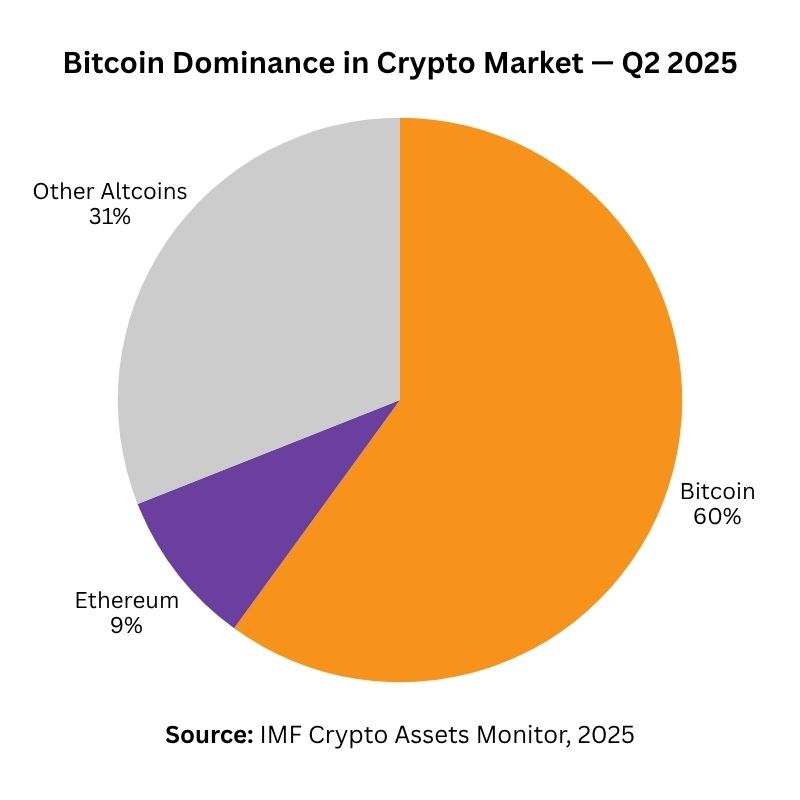
- → The total crypto market reached $3.5 trillion in 2025. Bitcoin holds 60% dominance. The stablecoin market hit $230 billion — 91% dollar-denominated.
- → Tether (USDT) — a privately issued, dollar-pegged token backed by ~$97 billion in US Treasury bonds — drives 65% of global stablecoin volume and dominates European crypto markets.
- → Europe’s real monetary sovereignty crisis is not Bitcoin. It is Tether. And that crisis is already here.
Christine Lagarde is right about Bitcoin. She is just answering the wrong question.
Let me be direct about something that most financial commentary on this topic refuses to say clearly: Bitcoin is not ready to be a European central bank reserve asset. Not today. Christine Lagarde’s rejection of Bitcoin at the ECB’s January 2025 press conference was institutionally correct. The volatility is real. The association with illicit finance is real. The absence of the liquidity and security standards that sovereign reserve management demands is real.
And yet — Lagarde being right about Bitcoin does not mean Europe has no problem. It means Europe has a different problem. A bigger one. One that is not being debated in Frankfurt boardrooms or Brussels policy papers with anywhere near the urgency it deserves.
While European institutions spend their energy being correct about Bitcoin, a privately issued, dollar-denominated instrument called Tether has quietly become the dominant currency of European crypto markets. Nobody voted for this. Nobody approved it. It just happened — one transaction at a time. This is the story that matters. Not whether Bitcoin deserves a seat at the ECB’s table. But what is already sitting at Europe’s table uninvited — and what it is slowly eating.
1. The ECB Is Right — And That Is Exactly the Problem
On January 30, 2025, Christine Lagarde stated at the ECB’s monetary policy press conference that reserve assets must be “liquid, secure, and safe” and must not be “plagued by the suspicion of money laundering or other criminal activities.” Her conclusion: “I am confident that Bitcoin will not enter the reserves of any of the central banks of the General Council.”
She is right. A central bank’s balance sheet is not a speculative portfolio. It is the bedrock of public monetary confidence. An asset that can lose half its value in four months — as Bitcoin did between October 2025 and February 2026, falling from $125,000 to under $70,000 — has no business sitting alongside gold and foreign currency reserves as a pillar of monetary stability.
The ECB’s own data confirms that crypto in Europe remains a retail phenomenon, not an institutional one. According to the ECB’s November 2024 Consumer Expectations Survey, 54% of European crypto holders have less than €1,000 invested. A full 91% hold less than €20,000. European banks allocate approximately 1.3% of their total assets to crypto-related instruments. These are not the numbers of an asset class that has earned institutional trust.
So Lagarde is correct. Bitcoin fails the reserve asset test today. The problem is that being correct has apparently made European institutions comfortable — comfortable enough to stop asking what else might be happening while they focus on winning this particular argument.
Institutional correctness is not the same as institutional awareness. Europe has plenty of the first. It is dangerously short on the second.
2. The One European Central Banker Who Is Asking Different Questions
On the same day Lagarde closed the door, Czech National Bank Governor Aleš Michl opened a window. His Bank Board approved a proposal to analyze Bitcoin for potential reserve diversification — and he backed it with a research paper that deserves more attention than it has received in mainstream European financial commentary.
Michl is not a Bitcoin evangelist. He is a central banker making a diversification argument — modest, orthodox, and grounded in portfolio theory. His research paper identifies five structural parallels between Bitcoin and gold that he believes warrant serious institutional consideration.
Bitcoin and gold share low correlation with other asset classes, relatively scarce supply, and a demonstrated history of functioning as a hedge against inflation and geopolitical instability. Bitcoin’s volatility — the ECB’s primary objection — is, in the CNB’s analysis, a transitional characteristic rather than a permanent one. As regulatory frameworks mature across major jurisdictions, market depth deepens and volatility historically declines. The CNB is not betting on Bitcoin. It is watching it, carefully, with $1 million of institutional skin in the game.
Most importantly, the CNB explicitly states that Bitcoin is not expected to replace the US dollar as the world’s primary reserve currency. This is a 5% portfolio diversification argument — the same cautious logic that led central banks to gradually add gold, then foreign currencies, then emerging market bonds to their reserve portfolios over decades.
“History appears to be repeating itself, with gold once similarly subject to skepticism, suspicion and demand speculation. We believe that Bitcoin adoption will continue, as regulatory developments, macroeconomic conditions and — above all — time should enable the public to increasingly embrace Bitcoin as a store of value.” — Czech National Bank Research Paper, 2025
Lagarde’s public response was to express confidence that Michl would eventually come around to her position. Perhaps he will. But there is something worth sitting with in that response — the ECB’s most powerful institutional voice did not engage with the CNB’s five arguments. It simply expressed confidence that they were wrong.
That is not analysis. That is authority. And authority without engagement is how institutions miss the moments that matter.
The Czech National Bank is running an experiment. The ECB is certain it already knows the result. History has a long record of punishing that kind of certainty.
3. Tether: The Real Story Nobody in Frankfurt Is Telling
Now we get to the part of this analysis that I believe matters most — and that mainstream European financial media is almost entirely failing to communicate with the seriousness it deserves.
While the ECB focuses its institutional attention on whether Bitcoin is too volatile for reserve use, something far more consequential is already operating inside European financial markets. It did not arrive through legislation. It was not approved by any European institution. It grew organically, through user adoption, because it was convenient — and because no European alternative existed.
It is called Tether. And it is, in the most precise sense of the phrase, a Trojan Horse inside Europe’s monetary system. I examine this in full detail in my dedicated analysis of Tether and its role in the global monetary system.
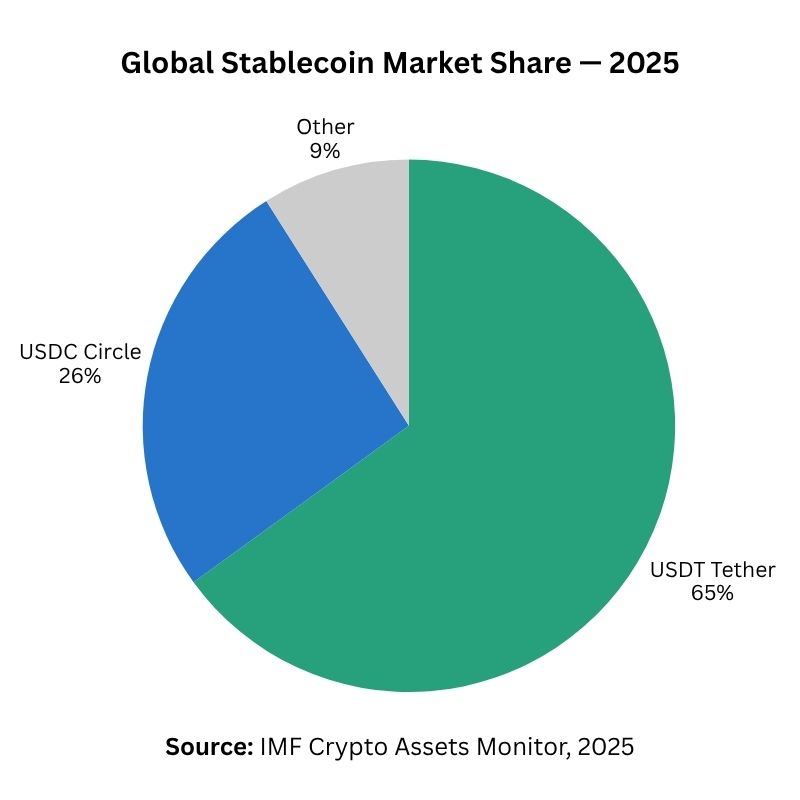
The numbers from the IMF’s 2025 Crypto Assets Monitor are stark. The total stablecoin market has reached $230 billion — an all-time high. Tether alone accounts for $150 billion of that, holding 65% market share. Its closest competitor, Circle’s USDC, holds 26%. Together, two American privately issued dollar-pegged instruments control 91% of the entire global stablecoin market.
In Europe specifically, the picture is even more concentrated. According to data cited in the Atlantic Council’s 2025 crypto policy analysis, USD-denominated stablecoins constitute 90% of crypto market capitalization and over 70% of trading volume across European markets. The euro-denominated equivalent? Negligible.
Every time a European citizen buys or sells crypto, they are almost certainly doing it through Tether. A dollar instrument. A private instrument. One that operates from El Salvador. One that holds approximately $97 billion in US Treasury bonds as its reserve backing — making it, by some measures, one of the largest holders of American government debt in the world.
Read that again slowly. A privately issued token, based in a lightly regulated Central American jurisdiction, backed by nearly $100 billion in US government debt, is the dominant transactional currency for European crypto participants. The ECB has no jurisdiction over it. MiCA does not meaningfully constrain it. And it grows larger every quarter.
The United States does not need to convince Europe to adopt the dollar in the digital age. Tether is doing it automatically — and Europeans are choosing it voluntarily.
This is the mechanism by which dollar hegemony extends itself into the 21st century financial system. Not through military power or diplomatic pressure. Through convenience. Through the absence of a credible European alternative. Through millions of small daily decisions made by ordinary people who simply want to trade crypto and reach for the most liquid, most familiar instrument available.
The IMF and G20 are not unaware of this dynamic. The joint IMF-FSB Synthesis Paper explicitly warns that dollar-denominated stablecoins in foreign markets can “undermine the effectiveness of monetary policy, circumvent capital flow management measures, and exacerbate fiscal risks.” But as the IMF itself acknowledges, regulatory implementation remains inconsistent. The G20 wants coherent global rules. Years of negotiations have not produced them. And while the frameworks are being written, Tether’s market cap grows.
The ECB’s answer is the Digital Euro — its own central bank digital currency, designed to give European citizens a regulated, sovereign, euro-denominated digital alternative. As I argued in a previous analysis on this site, the Digital Euro is fundamentally a sovereignty project dressed in the language of financial innovation. That project is real and necessary. But it remains years from meaningful deployment. Tether is not waiting.
The ECB is building a fortress to protect European monetary sovereignty. Meanwhile Tether has already set up a market stall inside the walls — and business is booming.
4. Two Strategies, One Winner — and Europe May Not Realize It Yet
Step back from the individual data points and what emerges is a fundamental divergence between how the United States and Europe have chosen to respond to the rise of digital assets — and the strategic consequences of those choices are only beginning to become visible.
America moved first and fast. The Trump administration’s Strategic Bitcoin Reserve, established by executive order in March 2025, is a geopolitical signal as much as a financial one. It says: we intend to shape the emerging monetary order, not regulate it from the outside. Combined with the unchecked growth of dollar-backed stablecoins, the US has simultaneously accumulated Bitcoin and ensured the dollar remains the reference currency for the entire digital asset ecosystem. Whether or not Bitcoin ultimately proves to be a legitimate long-term reserve asset, America has positioned itself to benefit either way.
Europe chose a different path. MiCA provides a regulatory framework. The Digital Euro provides a long-term vision. The ECB provides institutional resistance. None of these are wrong decisions in isolation. Together they form a coherent, cautious, legally rigorous response to digital assets that reflects European values around consumer protection, financial stability, and rule of law.
But coherence and caution do not protect monetary sovereignty on their own. And the data from the IMF tells a story that European policymakers should find deeply uncomfortable: the crypto market now represents 10% of the entire US Treasury debt market in capitalization. At its Q1 2025 peak, that figure reached 13%. This is no longer a niche. This is a parallel financial system — and it runs almost entirely on American rails.
Europe is not losing the Bitcoin debate. Europe is winning it. The problem is that the Bitcoin debate is not the one that decides the outcome.
Conclusion: The Right Answer to the Wrong Question
I want to be precise about what this analysis is and is not arguing.
It is not arguing that Bitcoin should be in the ECB’s reserve portfolio. It should not be — not today, not at this level of volatility, not without the institutional infrastructure and regulatory clarity that serious reserve management demands. Lagarde is right on that specific question.
What this analysis is arguing is that Europe’s institutional focus on that question — the correct answer to the Bitcoin question — has created a dangerous blind spot around Tether. Around dollar stablecoin dominance. Around the quiet, daily, voluntary erosion of European monetary sovereignty that is happening not because of Bitcoin, but because of the absence of a credible European digital monetary alternative.
The G20 cannot agree on stablecoin regulation. The Digital Euro is years away. MiCA does not meaningfully constrain Tether’s operations. And every day that European citizens transact in USDT is another day the dollar deepens its grip on European financial behavior — not through force, but through convenience.
That is the psychological trap. Not Bitcoin. Not the volatility. Not the criminal associations. The trap is that Tether feels like nothing — like a neutral tool, like a convenient number that happens to say “1 dollar” on the screen. It feels like infrastructure. And infrastructure, once embedded, is almost impossible to displace.
Europe will win the argument about Bitcoin. It may not notice until too late that the argument it was winning was never the one that mattered.
The monetary sovereignty war is not coming. It is already here. It just does not look like anyone expected it to look — it does not look like Bitcoin. It looks like a stablecoin. And it fits in your pocket.
References & Sources:
All sources used in this analysis are primary institutional publications or tier-1 financial media. No crypto-native blogs or unverified secondary sources have been used.
[1] ECB Financial Stability Review — Crypto Special Feature, May 2025
[2] ECB Press Conference — Lagarde Bitcoin Statement, Euronews, January 30 2025
[3] ECB President Lagarde Confident Bitcoin Won’t Enter EU Reserves — The Block
[4] IMF-FSB Synthesis Paper: Policies for Crypto-Assets, September 2023
[5] IMF Crypto Assets Monitor — 2025 Edition
[6] Will Central Banks Soon Begin Adding Bitcoin to Their Reserves? — International Banker, January 2026
[7] The 2025 Crypto Policy Landscape: EU and US Divergences — Atlantic Council
[8] G20 Crypto-Asset Policy Implementation Roadmap — IMF/FSB, October 2024
Disclaimer: This analysis is provided for informational purposes only and is based on publicly available institutional and financial documentation. It does not constitute financial or investment advice.
Did you find this article helpful?
Thank you for your feedback!