

On February 24, 2022, the United States and its allies froze $300 billion in Russian central bank reserves. It was the largest weaponization of the global financial system in modern history. The intended target was Russia. The actual audience was every central bank on earth that holds reserves in dollars. This article examines what happened next — and why the world’s response is reshaping the global monetary order more profoundly than any event since the collapse of Bretton Woods.
KEY TAKEAWAYS
- → On February 24, 2022, the US and allies froze $300 billion in Russian central bank reserves overnight. Every central bank on earth received the same message: dollar-denominated reserves held in Western institutions can be confiscated without warning.
- → In 5 of the top 10 annual increases in a country’s gold reserve share since 1999, the country involved faced sanctions in the same year or the previous year. The statistical link between sanctions and gold buying is now academically proven.
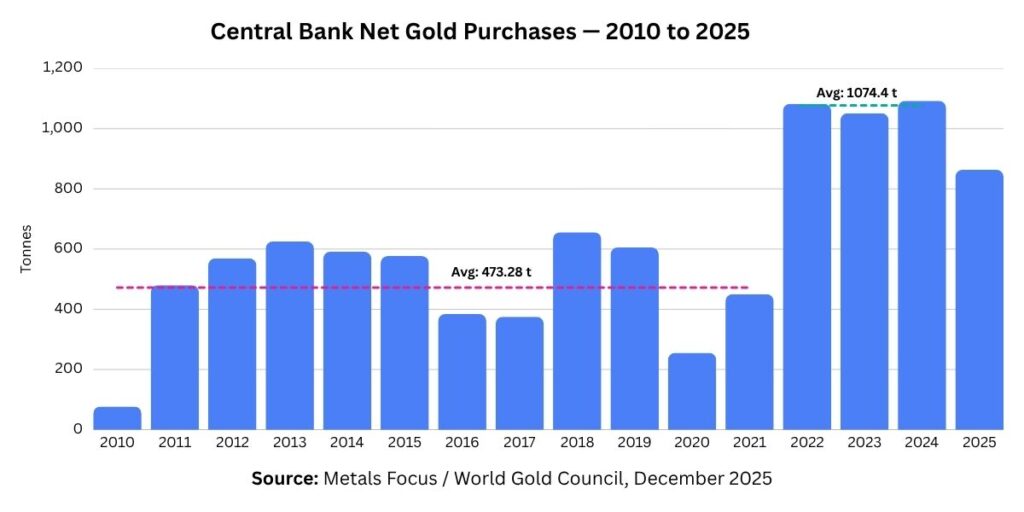
- → Central banks purchased over 1,000 tonnes of gold per year in 2022, 2023, and 2024 — more than double the pre-2022 decade average of 400–500 tonnes. The correlation with the sanctions event is not coincidental.
- → Gold has overtaken the US dollar in a key metric: for the first time since the 1970s, the value of gold held by foreign central banks now equals the value of US Treasuries they hold. The crossover is complete.
- → The correlation between gold prices and US real interest rates — which held for over a decade — broke permanently on February 24, 2022. Gold now rises even when conventional theory says it should fall. The rules have changed.
1. The Moment the Rules Changed
There is a specific date that serves as the dividing line between two eras of the global monetary system. Before February 24, 2022, central banks held dollar-denominated reserves with the assumption that those reserves were safe, liquid, and politically neutral. After that date, that assumption no longer holds.
When the United States, European Union, United Kingdom, and their allies froze $300 billion in Russian central bank reserves in response to the invasion of Ukraine, they demonstrated something that had never been demonstrated at that scale before: that reserve assets held within Western financial infrastructure are subject to confiscation based on political decisions made in Washington and Brussels. The assets did not disappear. They were frozen — rendered inaccessible to their legal owner — by administrative decree.
The financial logic behind the sanction was clear. Russia had accumulated those reserves over decades as a buffer against economic shocks. Freezing them removed the cushion, increased financial pressure, and was intended to force a policy change. Whether the sanction achieved its stated geopolitical objective is a separate debate. What it unambiguously achieved — as a side effect — was a global demonstration that sovereign reserve assets are not safe when they are held inside another sovereign’s financial jurisdiction.
This was not lost on anyone who holds reserves. Every central bank on earth had a front-row seat.
Gold, by contrast, cannot be frozen. Physical gold held in domestic vaults is outside the reach of any foreign jurisdiction. It cannot be sanctioned. It cannot be confiscated by administrative decree. It carries no counterparty risk — no issuing government, no central bank, no intermediary institution whose failure or political decision could render it inaccessible. These properties existed before February 2022. What changed was that the world received a vivid, real-time demonstration of their value.
This dynamic is not isolated to gold. As I examined in my analysis of Tether and the weaponization of dollar infrastructure, the United States has been systematically extending its financial reach through multiple channels simultaneously — stablecoins, sanctions, reserve currency dominance. Gold is the world’s oldest response to that reach. And it is currently the most effective one.
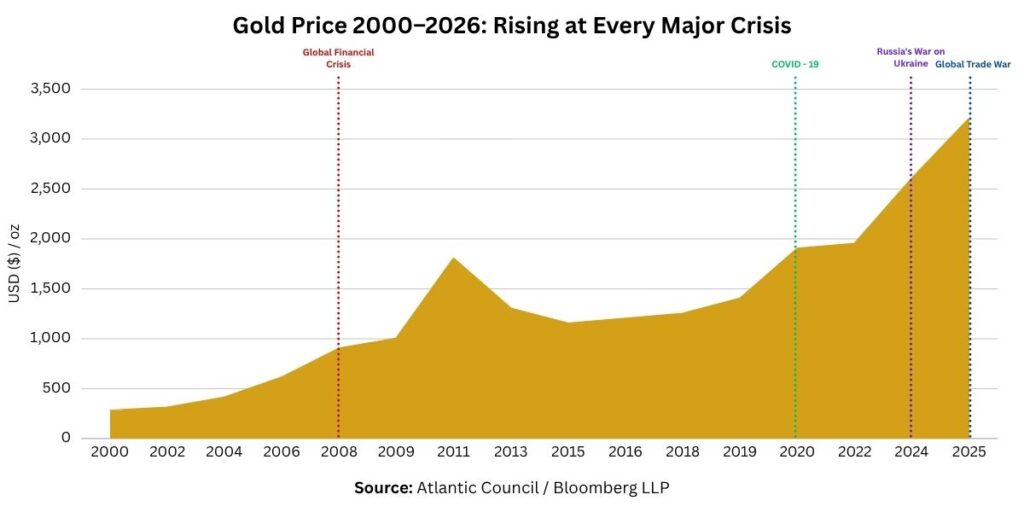
The chart above tells the story in visual terms. Gold rises at every major geopolitical and economic shock — the global financial crisis, COVID-19, Russia’s invasion of Ukraine, the global trade war. What the chart cannot fully capture is the qualitative shift that occurred in 2022: this was not merely a price spike driven by fear. It was the beginning of a structural reallocation by institutional actors who manage the world’s sovereign wealth.
2. What Sanctions Actually Do to Money
The academic literature on this question has now reached a clear conclusion. A landmark paper by Arslanalp, Eichengreen, and Simpson-Bell — three of the world’s most cited international monetary economists — establishes statistically that the imposition of financial sanctions by the United States, United Kingdom, European Union, and Japan is directly associated with an increase in the share of central bank reserves held in gold. This is not a hypothesis. It is an empirically confirmed relationship.
The mechanism is straightforward. When a country perceives itself as a potential target of Western financial sanctions, the rational response is to reduce its exposure to assets that can be frozen. Dollar-denominated assets held at Western institutions are the most exposed. Gold held in domestic vaults is the least exposed. The shift from the former to the latter is therefore a rational, systematic risk management response to the demonstrated use of financial sanctions as a geopolitical tool.
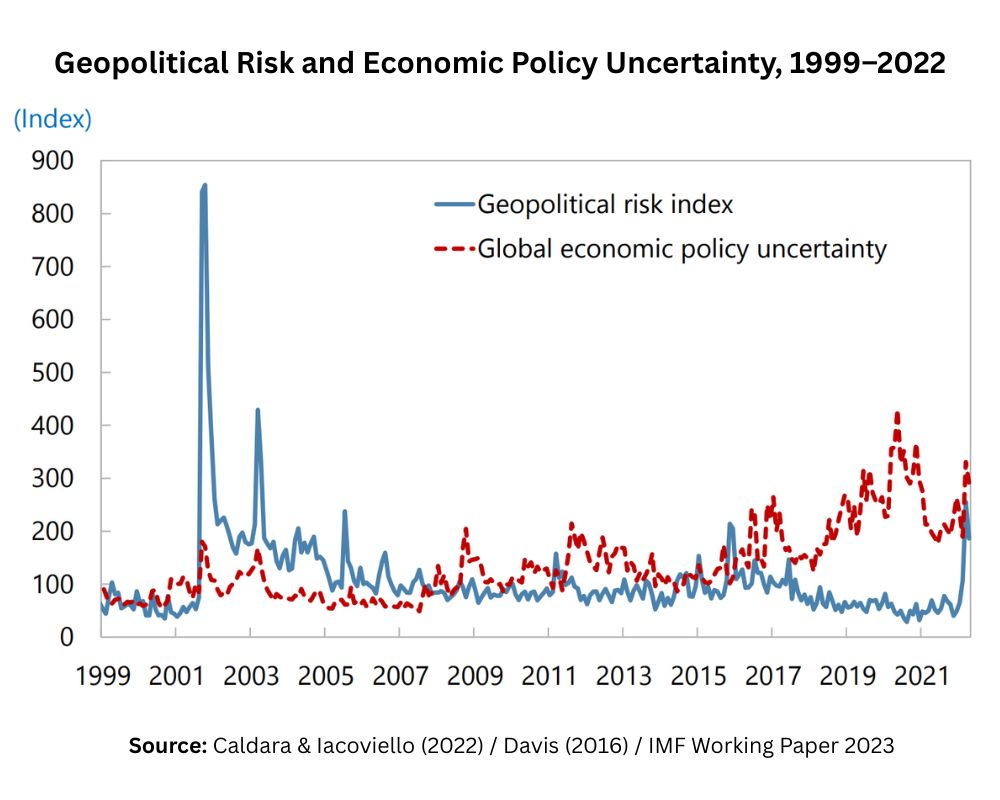
The chart above shows the scale of the problem. The share of countries globally that have been targeted by sanctions from the United States, EU, UK, or Japan rose from roughly 10% in 1990 to nearly 30% by 2019. That trajectory has continued since. As the sanctions net has expanded, so has the universe of countries with direct incentive to reduce their vulnerability to Western financial infrastructure.
The Atlantic Council’s analysis adds a dimension that is rarely discussed: the United States can theoretically reduce global gold demand by reducing sanctions. This is the mirror image of the same relationship. Sanctions are not merely a foreign policy tool. They are — inadvertently, as a side effect — a driver of gold prices and a catalyst for de-dollarization. Every expansion of the sanctions regime is simultaneously an advertisement for gold as a reserve asset.
The Kyrgyz Ministry of Finance’s creation of the USDKG stablecoin to facilitate trade with Russia, the construction of gold-for-oil payment channels through Dubai, the growing network of bilateral currency agreements designed to bypass SWIFT — these are not isolated incidents. They are symptoms of the same underlying dynamic: a global system of workarounds being constructed in real time by countries seeking to operate outside the reach of Western financial coercion.
The dollar’s power as a reserve currency and the dollar’s power as a weapon are the same power. Using one diminishes the other.
3. Russia: The Dress Rehearsal
Russia’s experience with gold is the most instructive case study available — not because it is unique, but because it is the most documented, the most extreme, and the most recent. Understanding what Russia did with gold between 2014 and 2022, and what happened to those reserves after the invasion, illuminates the logic that every other central bank is now applying to its own reserve strategy.
Following the annexation of Crimea in 2014 and the first wave of Western sanctions, Russia began a systematic, sustained program of gold accumulation. Over the following eight years, the Russian central bank became the single largest official sector buyer of gold globally — accumulating more than 60 million troy ounces and raising gold’s share of its total reserves dramatically. This was not a tactical move. It was a long-term strategic hedge against the scenario that eventually materialized in 2022.
When $300 billion in Russian reserves were frozen in February 2022, Russia’s gold holdings — held domestically and therefore outside Western jurisdiction — had appreciated significantly in value. The gold Russia accumulated between 2014 and 2022 offset approximately one-third of the losses from the frozen reserves, adding roughly $96 billion in value as prices rose in the aftermath of the invasion. The hedge was imperfect. But it worked.
The third-party response is equally revealing. The European Union and Canada imposed penalties on countries and institutions that continued to trade gold with Russia during the war — precisely because gold was functioning as a sanctions relief valve. If gold were not effective at circumventing financial pressure, there would have been no reason to target the gold trade. The fact that Western powers went to the trouble of sanctioning Russian gold transactions is itself evidence that gold works as a reserve asset under sanctions.
The chart above shows what happened to global central bank gold purchases after February 2022. The shift is visible and dramatic. From 2022 through 2024, central banks purchased over 1,000 tonnes per year — more than double the 2010–2021 annual average of approximately 473 tonnes. The two dashed lines tell the story: the pre-2022 baseline, and the new post-2022 normal. The gap between them represents a fundamental structural change in how sovereign institutions manage reserve risk.
In 2025, purchases moderated to 863 tonnes — still 82% above the pre-2022 average — as central banks navigated a rapid gold price rally that reached $5,595 per ounce in January 2026. The moderation was tactical, not strategic. The World Gold Council’s 2025 survey found that 95% of central banks expect global gold reserves to continue increasing. The Q4 2025 buying surge to 230 tonnes confirmed that the slowdown was temporary.
4. The Dollar’s Structural Weakness — From the Inside
The sanctions argument explains why central banks are running away from dollar-denominated assets. But there is a parallel argument — quieter, less discussed, but equally important — for why the dollar itself is structurally vulnerable from within, independent of any sanctions decision.
The IMF’s COFER data shows the dollar’s share of global official foreign exchange reserves has declined from 71% in 2001 to 54.8% in Q1 2024. This is a slow, persistent erosion — not a sudden collapse. What is significant is where the lost dollar share has gone. It has not moved primarily to the euro, the yuan, or any other major currency. It has fragmented into smaller currencies and, most consequentially, into gold. There is no heir to the dollar’s throne. And in the absence of a credible alternative currency, gold functions as the default destination for reserve diversification.
This fragmentation is directly relevant to the Digital Euro project I examined in an earlier analysis in this series. Europe’s failure to build a credible digital reserve instrument has left the field open — not to the yuan or any other challenger, but to gold and, paradoxically, to dollar-denominated stablecoins. The absence of a European monetary alternative is itself a driver of gold accumulation.
China’s trajectory is the most precise illustration of this dynamic. The People’s Bank of China has raised gold’s share of its reserves from 1.8% in 2015 to 4.9% currently — while simultaneously reducing its holdings of US Treasury bonds from $1.3 trillion in the early 2010s to $780 billion in mid-2024. This is not diversification. It is a deliberate, sustained, multi-year strategic repositioning. China is not simply buying gold. It is selling the dollar.
The fiscal dimension of dollar vulnerability compounds the geopolitical one. US interest payments on government debt are estimated to consume more than 20% of government revenue by 2025. The US national savings rate remains structurally low, insufficient to cover domestic investment, generating persistent current account deficits. These are not temporary cyclical conditions. They are structural features of an economy that has relied on reserve currency status to avoid the discipline that other countries face when they spend beyond their means.
The dollar’s weakness is being built from the inside as much as it is being pressured from the outside.
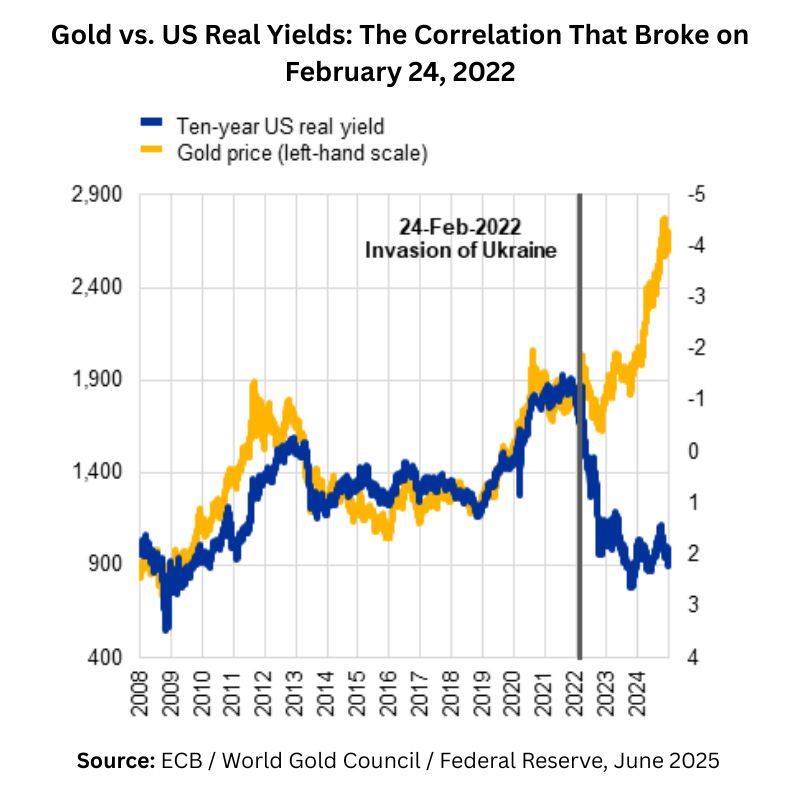
The ECB’s chart above captures the most analytically significant development in gold markets since the end of the gold standard. Between 2008 and early 2022, gold prices moved inversely with US real interest rates — a clean, predictable relationship that held for over a decade. Higher real yields meant lower gold prices. Lower real yields meant higher gold prices. Every sophisticated investor understood this relationship and priced it into their models.
On February 24, 2022, that correlation broke. Since the invasion of Ukraine, gold has risen alongside rising real yields — which conventional theory would predict should suppress gold demand. The breakdown means that geopolitical risk has become an independent structural driver of gold prices, operating on top of and separate from the traditional monetary drivers. Gold is no longer just an inflation hedge or an interest rate trade. It is now also a hedge against the weaponization of the financial system itself.
5. The New Gold Consensus
The most striking data point in the World Gold Council’s 2025 Central Bank Gold Reserves Survey is not a number about gold prices or tonnage. It is a survey result: 95% of central banks expect global official gold reserves to increase over the next 12 months. This is the highest level of consensus in the survey’s eight-year history. And it is near-unanimous.
For context: in 2019, only 54% of central banks expected global reserves to increase. In six years, that number rose to 95%. What changed is not gold’s fundamental properties — those have not changed in five thousand years. What changed is the perceived risk of the alternative. Dollar-denominated assets held in Western institutions now carry a political risk that they did not carry six years ago.
The ECB’s June 2025 analysis documents another milestone that deserves emphasis. Gold has overtaken the euro to become the world’s second-largest reserve asset, accounting for 20% of global official reserves compared to the euro’s 16%. Central bank gold holdings now stand at levels close to those last seen during the Bretton Woods era — the system under which gold was the explicit anchor of the entire international monetary order.
We are not returning to Bretton Woods. Gold is not being reinstated as the formal basis of the monetary system. But the direction of travel is unmistakable: the world’s central banks are voluntarily increasing their gold allocations, repatriating gold from Western custodians into domestic vaults, and reducing their exposure to dollar-denominated assets. This is happening slowly, systematically, and without formal announcement. It is a quiet revolution in reserve management.
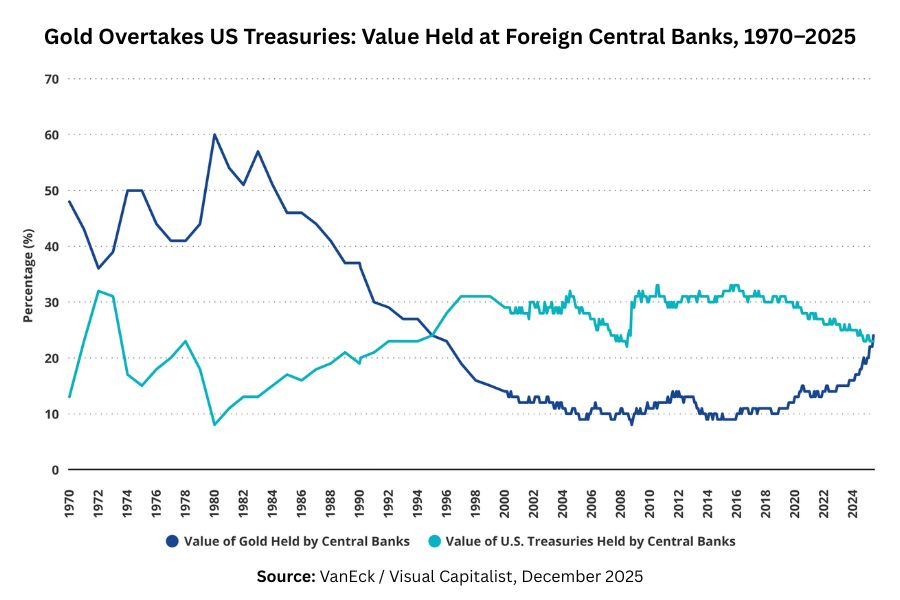
The VanEck chart above shows the full historical arc in a single image. From 1970 through the mid-1990s, gold dominated. Then Treasuries surged as the dollar’s reserve currency status deepened through globalisation and the technology boom. By the early 2000s, Treasuries held a commanding lead. For two decades, the dollar-denominated financial system appeared unchallengeable.
Then the lines began converging. And by December 2025, they had crossed. The value of gold held by foreign central banks now equals the value of US Treasuries they hold. It is not a dramatic single event. It is the culmination of a decade-long structural reallocation, accelerated by the events of February 2022.
The Atlantic Council’s analysis adds the most uncomfortable dimension of this picture for Western policymakers: gold-backed digital assets are creating an enforcement blind spot for US sanctions. Countries are not just accumulating physical gold. They are building gold-backed trading systems and digital assets that operate entirely outside dollar-denominated financial infrastructure. If these systems achieve critical mass, Washington may not merely lose leverage over sanctioned economies — it may lose visibility into what those economies are doing entirely.
Conclusion: The Weapon That Cuts Both Ways
The weaponization of the dollar is not a new idea. The United States has used financial sanctions as a foreign policy tool for decades. What changed in February 2022 was not the intent behind sanctions, but their scale — $300 billion in a single operation — and the global audience that witnessed it. Every central bank managing sovereign reserves received the same implicit message: what happened to Russia can happen to anyone.
The response has been measured, systematic, and unmistakable. Central banks have purchased gold at historically unprecedented rates for three consecutive years. The correlation between sanctions exposure and gold accumulation is now statistically proven. The traditional inverse relationship between gold and real interest rates has broken down. Gold has overtaken the euro as the world’s second-largest reserve asset. The value of gold at foreign central banks has crossed the value of US Treasuries for the first time since the 1970s.
None of this represents the collapse of the dollar. The dollar remains by far the dominant reserve currency. US Treasuries remain the world’s largest and most liquid safe asset market. The institutional inertia of the dollar system is enormous. But the direction of travel has changed. And directions of travel, once established and embedded in the reserve management strategies of dozens of sovereign institutions, are not easily reversed.
The dollar’s greatest strength — its role as the world’s reserve currency — and its greatest vulnerability are now the same thing. You cannot weaponize a reserve currency without creating an incentive to find alternatives to it.
Gold is not the alternative. It is the interim destination while the alternative is being built. The second part of this analysis — Gold Never Left. The Numbers Prove It. — examines what the data says once central banks get there: the performance record, the supply constraints, the inflation hedge proof, and the most provocative long-term price calculation in institutional finance.
References & Sources:
All sources used in this analysis are primary institutional publications, peer-reviewed academic research, or tier-1 financial media. No crypto-native blogs or unverified secondary sources have been used.
[1] Atlantic Council — Gold’s Geopolitical Comeback, May 2025
[2] Atlantic Council — Going for Gold: Does the Dollar’s Declining Share Matter?, December 2025
[3] ECB — Gold Demand: The Role of the Official Sector and Geopolitics, June 2025
[4] Arslanalp, Eichengreen & Simpson-Bell — Gold as International Reserves: A Barbarous Relic No More?, IMF Working Paper, January 2023
[5] World Gold Council — Central Bank Gold Reserves Survey 2025
[6] World Gold Council — Gold Demand Trends Full Year 2025, January 2026
[7] VanEck — Gold Investment Outlook 2026, February 2026
[8] Reuters via Yahoo Finance — Central Banks on Track for 4th Year of Massive Gold Purchases, June 2025
Disclaimer: This analysis is provided for informational purposes only and is based on publicly available institutional and financial documentation. It does not constitute financial or investment advice.
Did you find this article helpful?
Thank you for your feedback!