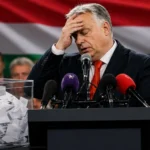

On April 19, 2026, Bulgaria elected Rumen Radev — the man who campaigned hardest against how the euro was adopted — as its next Prime Minister with a historic 44.59% majority. The euro has been in Bulgarian pockets since January 1st. The lev is gone. And yet the political revolt against the manner of its adoption has just received an overwhelming democratic mandate. This article asks: what does a Radev government mean for Bulgaria’s monetary sovereignty, its relationship with the ECB, its long-overdue institutional reform agenda — and for the broader European question of whether monetary union can survive without genuine democratic legitimacy?
KEY TAKEAWAYS
- Bulgaria adopted the euro on January 1, 2026, without a public referendum — 49% of Bulgarians opposed it according to the final Eurobarometer survey.
- Radev’s landslide victory (44.59%) represents a democratic rebuke of how monetary sovereignty was transferred — not a rejection of EU membership itself.
- Bulgaria has had no independent monetary policy since 1997; the euro is economically irreversible regardless of political sentiment.
- PB’s first priority is institutional: replacing the Supreme Court leadership, the Attorney General, and senior police and military directors — the nodes through which GERB and DPS-NN maintained impunity for years.
- Under GERB’s governance, Bulgaria became one of the EU’s poorest countries. Bulgaria’s total external debt surged from €45.75 billion at end-2023 to over €54 billion by November 2025.
- Radev’s “pragmatist” stance positions him as a friction-point inside the eurozone — not an exit threat, but a source of institutional tension.
- The Bulgarian case is a preview of a systemic European risk: what happens when monetary integration outruns democratic consent?
1. The Paradox of January 1st
At midnight on January 1, 2026, Bulgarian crowds gathered in freezing temperatures outside the Bulgarian National Bank in Sofia. Euro banknotes were dispensed. The Madara Rider — Bulgaria’s ancient golden horseman — appeared on the new coins. Christine Lagarde lit up the ECB’s Frankfurt headquarters in Bulgarian colours and declared the country officially part of the European monetary family.
Three months and nineteen days later, Bulgarian voters delivered a verdict that Brussels was not expecting in this form: 44.59% of the vote — a near-absolute parliamentary majority — handed to Rumen Radev, the man who had spent the previous year demanding that the entire euro adoption process be submitted to a public referendum. A man who, on the night the lev ceased to exist, went on national television not to celebrate, but to criticise.
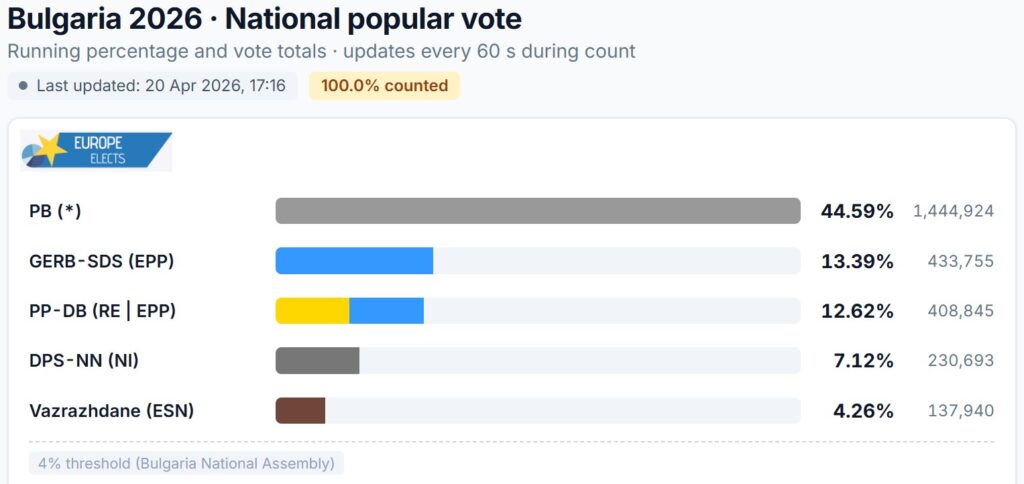
The scale of Radev’s victory is difficult to overstate. Progressive Bulgaria received 1,444,924 votes — more than three times the vote share of the once-dominant GERB party, which collapsed to 13.39%. The pro-European PP-DB coalition held at 12.62%. Peevski’s DPS-NN received 7.12%. The pro-Russian Vazrazhdane scraped through at 4.26%. Every other party failed to clear the 4% threshold.
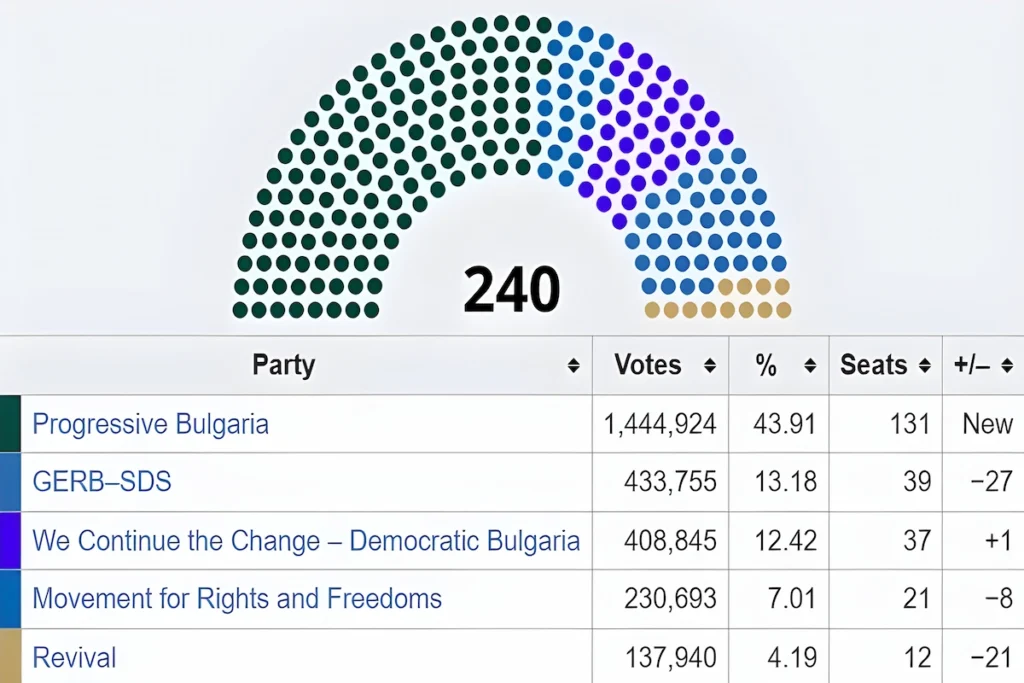
Bulgaria 2026 National Assembly — Seat Distribution (240 seats total) | Source: Wikipedia
“Those in power chose not to listen to the citizens. This refusal was one of the dramatic symptoms of the deep divide between the political class and the people.” — Rumen Radev, New Year’s address, January 1, 2026
The seat distribution makes the dominance even more concrete. Progressive Bulgaria secured 131 of 240 seats in the National Assembly — more than GERB, PP-DB, DPS-NN and Vazrazhdane combined. This is not a plurality. It is a structural majority that requires no coalition, no negotiation, and no compromise to govern.
The paradox is both sharp and instructive. Bulgaria is now a eurozone member. The lev is gone — irretrievably, legally, institutionally. And the country’s new Prime Minister is a man who believes the process by which this happened was fundamentally illegitimate.
2. Who Is Radev, and What Did He Actually Say?
Western media have reached for convenient labels: eurosceptic, pro-Russian, populist. None of these are quite accurate, and the imprecision matters for understanding what his government will actually do.
Radev served two terms as Bulgaria’s president (2017–2026). During his presidency, Bulgaria voted for all EU anti-Russian sanctions, remained in NATO, and — critically — the euro adoption law was signed into force under his signature in August 2024. He is not an anti-EU politician in the Viktor Orbán mold. He has explicitly declared that Bulgaria will “continue on its European path.”
What Radev opposed was not the euro per se — it was the democratic process surrounding its adoption, or rather the absence of one. When the final Eurobarometer survey showed that 49% of Bulgarians opposed the euro and only 42% were in favour, Radev called for a referendum. Parliament blocked it on constitutional grounds. Radev called this “dismissive disregard for the will of the people.”
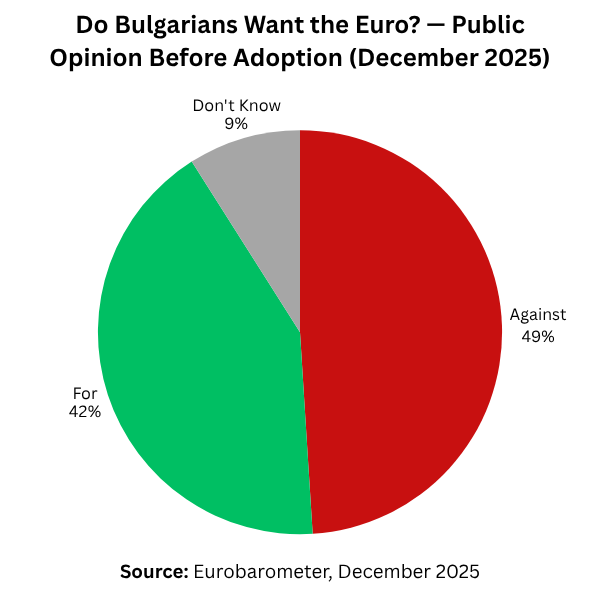
The chart above tells a story that Brussels preferred not to highlight: a majority of Bulgarian citizens opposed the currency they were handed. This was not a fringe position — it was the democratic majority, systematically overridden by institutional process. Radev’s campaign weaponised this legitimacy gap with devastating electoral effectiveness. At a pre-election rally he told voters directly: “The coalition-makers introduced the euro in Bulgaria without asking you. And now, when you pay your bills, always remember which politicians promised you that you would be in the ‘club of the rich.'”
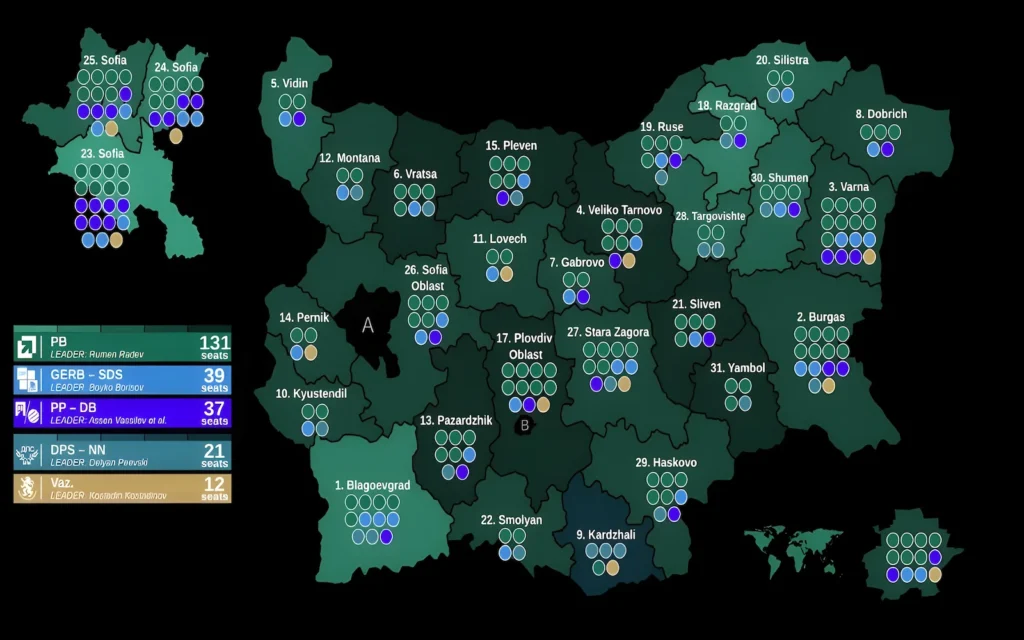
Bulgaria 2026 Parliamentary Election — Results by District | Source: Wikipedia
The geographic breakdown reveals something equally striking. PB’s dominance is not concentrated in Sofia or urban centers — it is nationwide. From Vidin in the northwest to Kardzhali in the south, the green of Progressive Bulgaria covers virtually every electoral district in the country. This is not a city party that won an election. This is a national mandate.
3. The Price of GERB: How Corruption Kept Bulgaria Poor
To understand why Radev’s mandate is so decisive, it is necessary to understand what GERB’s governance actually cost Bulgaria over the past decade and a half.
Bulgaria is the European Union’s poorest member state by GDP per capita. This is not a natural condition — it is a political one. Under successive GERB-dominated governments, the country’s institutional architecture was systematically subordinated to the interests of a narrow political-business network. Two figures define this network in the public consciousness: Boyko Borisov, GERB’s leader, who narrowly avoided a Magnitsky Act designation reportedly only due to his incumbency at the time; and Delyan Peevski, the leader of DPS-NN, who is formally listed under the US Magnitsky Act for corruption.
The economic record speaks clearly. Bulgaria’s total external debt surged from €45.75 billion at the end of 2023 to over €54 billion by November 2025 — an increase of nearly €8.5 billion in under two years. Government debt-to-GDP, which had been among the lowest in the EU, is now forecast to rise from 23.8% in 2024 to 32.6% by 2027. The Zhelyazkov government’s 2026 budget — which triggered the mass protests that brought it down — included a 50% salary increase for police and security forces, alongside large-scale infrastructure spending that critics consistently described as politically motivated public money distribution rather than genuine development investment.
The judicial dimension of GERB’s governance is equally damning. In January 2026, Kiril Petkov — former Prime Minister and co-leader of PP-DB — made a striking public claim: that approximately 70 criminal case files exist against Borisov, all opened, none ever pursued to prosecution. According to Petkov, the fact that not a single one was activated is not coincidence — it is the system working as designed. Whoever controls the Attorney General controls the cases. And whoever controls the cases controls Borisov. This is not a fringe allegation. It is a structural description of how political impunity was maintained in Bulgaria for over a decade — and it is precisely why replacing the Attorney General is PB’s first institutional priority, not an afterthought.
Meanwhile, the brief PP-DB-led governing period delivered measurable economic improvement: real wage growth, pension increases, and GDP growth that outpaced the regional average. It was cut short by political obstruction before it could consolidate. The contrast between what institutional reform produced in a short window and what captured governance produced over years is not a matter of interpretation — it is written in the data.
Radev’s 44.59% is not simply an anti-euro vote. It is a generational reckoning with a governing model that systematically extracted value from Bulgarian citizens while promising European prosperity.
4. Monetary Sovereignty: What Bulgaria Actually Lost (and When)
Here is the analytical reality that Radev’s victory cannot change: Bulgaria surrendered meaningful monetary sovereignty not in January 2026, but in July 1997.
That was when Bulgaria, reeling from a catastrophic banking and currency crisis that wiped out savings and triggered hyperinflation, installed a currency board — fixing the lev to the Deutsche Mark at 1.95583, requiring 100% foreign reserve backing for every lev in circulation, and stripping the Bulgarian National Bank of any ability to set interest rates independently.
For nearly three decades, Bulgaria had the form of monetary sovereignty but not the substance. Joining the eurozone on January 1, 2026 actually gave Bulgaria something it had lacked: an institutional voice. The BNB Governor now sits on the ECB Governing Council. The country gained representation in the monetary architecture that had been governing its economy from Frankfurt without its participation since 1999.
“It is not about losing sovereignty, but about moving to a new, higher level of participation in the European monetary architecture.” — BNB Governor Dimitar Radev
The debate was never really about monetary sovereignty — Bulgaria had already traded that away in 1997. It was about democratic legitimacy, transparency, and the distribution of the costs and benefits of deeper European integration. Those are valid concerns. They simply require a different analytical frame than “we lost our currency.” The implications of Bulgaria’s ECB membership extend beyond interest rate policy. As this publication has previously explored, the Digital Euro project represents a broader shift in how monetary control is exercised across the eurozone — one that will affect Bulgarian citizens just as directly as any other member state. Read: The Digital Euro: A Psychological Trap?
5. Beyond Parliament: The Institutional Purge That Must Come First
Electoral victory means nothing if the institutions that enforce the law remain staffed by loyalists of the previous system. This is the first lesson of every genuine anti-corruption transition in post-communist Europe, and it is the first real test Radev’s government faces.
PB’s immediate institutional agenda is clear: replacing the leadership of the Supreme Court, the Attorney General, and the senior directorate of the police and military. These are not ceremonial positions. They are the nodes through which the GERB–DPS-NN network maintained de facto impunity for over a decade. Prosecutions were selectively initiated and dropped. Investigations into politically connected business interests were slow-walked or buried. The judicial system functioned less as a check on power than as an instrument of it.
With an outright parliamentary majority, PB has the votes to move on these appointments without negotiating with any coalition partner. The expected alignment with PP-DB in parliament on judicial reform and anti-corruption legislation creates an additional reform bloc — but PB does not depend on it. This is the first time in Bulgaria’s recent parliamentary history that a single formation commands the numbers to pursue systemic institutional change without being vetoed by the very interests it seeks to investigate.
Peevski’s Magnitsky designation by the US Treasury is not symbolic — it is a legal constraint with real financial consequences for anyone doing business with his network. A Bulgarian Attorney General and judiciary that takes that designation seriously, rather than ignoring it as previous governments effectively did, would represent a fundamental shift in how Bulgaria’s rule-of-law obligations are enforced in practice. It would also unlock EU structural fund access more efficiently and strengthen Radev’s standing within European institutions.
6. What a Radev Government Can and Cannot Do
What Radev cannot do: Bulgaria cannot leave the eurozone. There is no legal mechanism for a member state to exit the single currency area. Euro adoption is a one-way door. The conversion rate of 1.95583 lev per euro is permanently retired. Any government that attempted to reconstruct a national currency would face capital flight, legal chaos, and banking system collapse.
What Radev can do: He can create friction. Bulgaria under his government will likely oppose ECB policy positions it considers misaligned with Bulgarian economic realities and push back against EU fiscal rules that constrain domestic spending. Analysts comparing him to Slovakia’s Robert Fico — a difficult but ultimately manageable EU member — are probably closer to the truth than those reaching for the Orbán comparison. Radev has already signalled willingness to cooperate with pro-European parties on judicial reform, and his absolute majority actually provides something Bulgaria has desperately needed: governmental stability.
7. The Deeper Question Europe Is Not Asking
The Bulgarian election result sits at the intersection of two long-running European crises. The first is the political crisis of technocratic legitimacy. Bulgaria’s parliament blocking a referendum on constitutional grounds is a paradigmatic instance of this dynamic — legally defensible, democratically corrosive. The second is the structural flaw of monetary union without fiscal union: ECB interest rate decisions calibrated for German and French economic cycles will systematically misfire in Sofia.
“A strong Bulgaria and a strong Europe need critical thinking and pragmatism. Europe has fallen victim to its own ambition to be a moral leader in a world with new rules.” — Rumen Radev, election night, April 19, 2026
The danger is not that Bulgaria exits the eurozone. The danger is subtler: that the eurozone accumulates enough governments governing against their own monetary framework that the ECB’s political authority — distinct from its legal authority — begins to fray from within. Not a dramatic rupture, but a slow institutional sclerosis.
8. Conclusion
Bulgaria’s April 2026 election is not the story mainstream European media will write: another populist threat to the liberal order. It is something more structurally revealing — the story of a country that gave up its monetary sovereignty in 1997, formalised that surrender in 2026 through an institutionally legitimate but democratically contested process, and then immediately elected the man who had loudest opposed the manner of that formalisation, alongside a mandate to dismantle the corrupt institutional apparatus that impoverished the country for a generation.
The lev is gone. The ECB is Bulgaria’s monetary authority. Neither Radev nor any electoral majority can change this. But what the vote revealed is that monetary integration without democratic ownership creates a political debt that eventually comes due — not in the form of currency collapse, but in the form of governments that are technically inside the system while being culturally and politically at odds with it.
Whether Radev uses his historic majority to genuinely clean Bulgaria’s institutions or simply to replace one set of loyalists with another will define his legacy more than any position he takes on the euro. The mandate exists. The tools are there. The question is whether the will is real. Europe should be watching — not with fear, but with honest self-reflection. Bulgaria’s dysfunction was not born in a vacuum. It was nurtured inside the EU for two decades.
References & Sources:
1. Euronews: “Bulgaria’s former President Rumen Radev wins parliamentary election by landslide” — April 19, 2026
2. Al Jazeera: “Bulgaria’s former President Radev wins election: All you need to know” — April 20, 2026
3. Balkan Insight: “Ex-President Rumen Radev Claims Parliamentary Majority in Bulgarian Election” — April 20, 2026
4. European Central Bank: “Bulgaria introduces the euro” — January 1, 2026 | ecb.europa.eu
5. Eurobarometer, Autumn 2025: “Introduction of the euro in Member States” — European Commission
6. Euronews: “Who is Rumen Radev, the former fighter pilot on course to be Bulgaria’s next PM?” — April 20, 2026
7. Novinite: “Bulgaria’s Gross External Debt Reaches €49.019 Billion by End of 2024” — 2025
8. Economic.bg: “Sharp jump in Bulgarian foreign debt in November” — January 2026
9. European Commission: “Economic Forecast for Bulgaria” — Autumn 2025
10. Wikipedia: “Bulgaria and the euro” (referenced April 21, 2026)
11. Town.bg: “70 преписки на трупчета: Кирил Петков с остър удар по Борисов” — January 17, 2026 | town.bg
12. Wikipedia: “2026 Bulgarian parliamentary election” (referenced April 23, 2026)
13. Europe Elects: “Bulgaria 2026 · National popular vote” (referenced April 21, 2026)
Disclaimer: This article is published for informational and analytical purposes only. It does not constitute financial, legal, or investment advice. The views expressed are those of the author based on publicly available information. Readers should conduct their own research before making financial or investment decisions.
Did you find this article helpful?
Thank you for your feedback!